The Ministry of Foreign Affairs condemns the decision and insistence of the Biblical Archaeology Society to arrive in the Republic of Cyprus through the illegal airport in Tymbou in the Turkish occupied areas and to arrange hotel accommodation in Keryneia in usurped Greek Cypriot property. [Read more…]
Statement by the Minister of Foreign Affairs regarding the killings of civilians in Syria, May 30, 2012
May 30, 2012
The Minister of Foreign Affairs, Dr Erato Kozakou-Marcoullis, made the following statement today regarding the recent killings of civilians in El-Houleh, Syria: [Read more…]
Address by the Minister of Foreign Affairs, Dr Erato Kozakou-Marcoullis, on “New Challenges and Prospects in the Eastern Mediterranean: The Cyprus Perspective,” at the Paasikivi Society think tank, in Helsinki
May 10, 2012
It is a great pleasure for me to be with you today at the prestigious Paasikivi Society in Helsinki, in a country and a city very close to my heart, since I have spent some of the most beautiful years of my life in Finland as a postgraduate student, in the 1970’s. [Read more…]
Logo of the Cyprus Presidency of the Council of the European Union presented on Europe Day
May 9, 2012

The vision of the Cyprus Presidency is one for a Better Europe, more hospitable, closer to its citizens, its neighbours and the world at large but also more efficient in facing today’s challenges. This is the message that the Logo of the Cyprus Presidency of the Council of the European Union conveys, revealed today by the Deputy Minister for European Affairs Ambassador Mr. Andreas D. Mavroyiannis at a special ceremony held at the CYPRESS Media Centre of the FILOXENIA Conference Centre in Nicosia. [Read more…]
Το Κυπρο-Αμερικανικό Επιμελητήριο τίμησε την Εταιρεία Noble Energy – 4 Μαΐου 2012
May 4, 2012
Στο πλαίσιο του ετήσιου δείπνου του που πραγματοποιήθηκε στη Νέα Υόρκη στις 4 Μαΐου, το Κυπρο-Αμερικανικό Εμπορικό Επιμελητήριο τίμησε την αμερικανική εταιρεία Noble Energy και τον Πρόεδρο και Διευθύνοντα Σύμβουλο [Read more…]
Address by the Minister of Foreign Affairs, Dr Erato Kozakou-Marcoullis, before the American Jewish Committee Global Forum, in Washington DC, May 3, 2012
May 3, 2012
I want to thank the American Jewish Committee (AJC) for inviting me to join you here in Washington, a city where I served as Ambassador for five years and from which I have very fond memories. [Read more…]
Cyprus Permanent Representative Elected Chairman of the UN Committee on Relations with the Host Country
April 30, 2012
On Monday, April 30 2012, the Permanent Representative of Cyprus to the UN Ambassador Nicholas Emiliou was elected by consensus as the new Chairman of the UN Committee on Relations with the Host Country [Read more…]
Cyprus: not enough progress in talks to call for international conference – Ban Ki-moon
April 22, 2012
United Nations Secretary-General Ban Ki-moon today informed the leaders of Cyprus’ Greek Cypriot and Turkish Cypriot communities, Demetris Christofias and Derviþ Eroðlu, that there was not enough progress on key aspects of reunification talks to warrant holding an international conference on the divided Mediterranean island nation. [Read more…]
Cyprus Problem in Brief
April 10, 2012
The Republic of Cyprus has, since September 20 1960, been a member of the United Nations and over the years has become a member practically of all its specialized agencies. It is a member of the Commonwealth, the Council of Europe and the Organization on Security and Co-operation in Europe.
In 1990 the Cyprus Government applied to become a member of the European Union and on May 1st 2004 it acceded the EU as a full member.
Cyprus is the third largest island in the Mediterranean with a long history whose origins go back nine thousand years. Its geographical position and its natural resources have always made it a target for conquerors. The Phoenicians, Assyrians, Egyptians, Persians, Romans, Arabs, the Frankish dynasty of the Lusignans, the Venetians, Ottoman Turks and the British, all conquered Cyprus in turn.
The settlement of Mycenaeans on the island in the 12th century B.C. gave the island its Greek character, which was maintained despite the influences and subjugations it went through during its chequered history.
The transfer of power in 1878 from Turkish to British rule allowed the national movement in Cyprus to grow, culminating in the 1931 uprising and the 1955-59 liberation movement. In 1960 Cyprus was declared an independent Republic as a result of the Zurich-London agreements. The 1960 constitution contained functional shortcomings, which led to deadlocks and to the intercommunal clashes of 1963/64. Turkey threatened to intervene militarily in Cyprus but international pressure prevented a military invasion in 1964 and 1967.
Following the threats by Turkey against Cyprus, the Government of the Republic brought the matter to the UN Security Council. The Security Council unanimously adopted resolution 186 of 4 March 1964, whose basic principles have guided international actions on Cyprus ever since:
– Established the UN Secretary-General’s mission of good offices aiming at a peaceful solution on the basis of an agreed agreement in accordance with the UN Charter
– Created UNFICYP, the UN Peacekeeping Force in Cyprus
– Reaffirmed the sovereignty and continuing existence of the Republic of Cyprus
– Reaffirmed the continuity of the government of the Republic of Cyprus
On 20 July 1974, Turkey using as a pretext the Coup of 15 July against the legal Government of the Republic of Cyprus, invaded the country, in violation of the UN Charter and fundamental principles of international law. The dire consequences of the invasion and subsequent military action by Turkey, are still felt today by the people of Cyprus. The military occupation, forcible division, violation of human rights, massive colonization, cultural destruction, property usurpation and ethnic segregation imposed since Turkey’s military invasion remain the main characteristics of the status quo on the island.
Today, Turkey, an aspiring member of European Union, stands guilty of international aggression against a member-state of the EU and the UN. This is certainly a totally unacceptable state of affairs, an affront to the international legal order and an ongoing threat to regional stability that must be urgently redressed.
Results of the Turkish Invasion and Occupation
-36, 2% of the sovereign territory of Cyprus is still under illegal military occupation by Turkey.
-Some 200,000 Greek Cypriots – about one third of the total population – who were forcibly expelled from the occupied northern part of the island (where they constituted about 70% of the population) are still deprived of the right to return to their homes and properties.
-About 1,400 persons (among them several hundred civilians) are still missing, while Turkey refuses to cooperate in ascertaining their fate.
-Some 400 Greek and Maronite Cypriots, out of 20,000 at the end of August 1974, remain enclaved in their villages which are still occupied. These people are living under conditions of oppression, harassment and deprivation. The rest were forced to abandon their homes and become refugees in their own country.
-About 35,000 troops from Turkey, heavily armed with the latest weapons supported by air, land and sea power, are illegally stationed in the occupied area, making it one of the most militarized regions in the world.
-Some 160,000 settlers from Turkey have been illegally brought to colonize the occupied area and alter the demographic structure of Cyprus.
-58,000 out of the 116,000 Turkish Cypriot population have emigrated from the island since Turkey’s invasion, according to Turkish Cypriot sources, because of the economic, social and moral deprivation which prevails in the occupied areas. Turkish Cypriots are now vastly outnumbered by troops and settlers from Turkey.
-Illegal construction on Greek Cypriot land and illegal sale of property owned by Greek Cypriots who were forcibly expelled from their homes by Turkey’s invasion has intensified. This unprecedent usurpation of property is yet another flagrant violation of human rights by the Turkish side.
-Turkey and the illegal Turkish Cypriot regime continue to destroy, deliberately and methodically, the Hellenic and Christian cultural and historical heritage in occupied Cyprus.
A series of UN General Assembly and Security Council resolutions, as well as resolutions adopted by numerous other international organizations, reflect the universal condemnations of Turkey’s invasion and all subsequent acts of aggression against Cyprus; demand the return of the refugees to their homes in safety and the tracing of the missing persons; and call for respect for the human rights of all Cypriots as well as for the independence, sovereignty and territorial integrity of Cyprus. Moreover, the European Court of Human Rights has found the government of Turkey responsible for gross and systematic violations of Human rights in Cyprus.
An end to occupation
The Cyprus problem is not an intercommunal dispute. It is a question of invasion and continuing occupation. Turkey continues unpunished to show contempt for the calls of the international community, as expressed in dozens of UN resolutions and continues to maintain the occupation and artificial division of the island. Successive rounds of UN-sponsored talks between the Greek and Turkish Cypriot communities to resolve the Cyprus problem have been undermined by the Turkish side which has sought a settlement that in effect would leave Cyprus permanently divided and hostage to foreign interests.
The basis and the framework for the solution of the Cyprus problem are provided for by the relevant UN resolutions and the high-level agreements between the representatives of the two communities. The basis of the solution is a bizonal bicommunal federation with political equality as described in the UN resolutions with a single citizenship and single international personality, safeguarding the human rights and the basic freedoms of all the citizens.
The Cyprus Government is firmly committed to finding a just and viable solution through negotiations based on UN resolutions-a solution that would safeguard the independence, sovereignity and territorial integrity of the Republic of Cyprus, would ensure the withdrawal of Turkish troops and colonists and secure the human rights and basic freedoms of all Cypriot citizens. For a solution to be viable and to withstand the test of time, it must be perceived as fair by the people who will have to live with it. It, therefore, must be democratic, just, workable, financially viable and compatible with EU acquis communautaires. Cyprus must remain a unified state where all of its citizens, Greek Cypriots, Turkish Cypriots, Maronites, Armenians and Latins would live harmoniously in a peaceful and prosperous Cyprus within the wider European family.
More information on the various dimensions of the Cyprus problem can be found on the website www.moi.gov.cy/pio and in numerous publications of the Press and Information Office (PIO).
Ambassador Nicholas Emiliou presents credentials to the UN Secretary-General
April 9, 2012
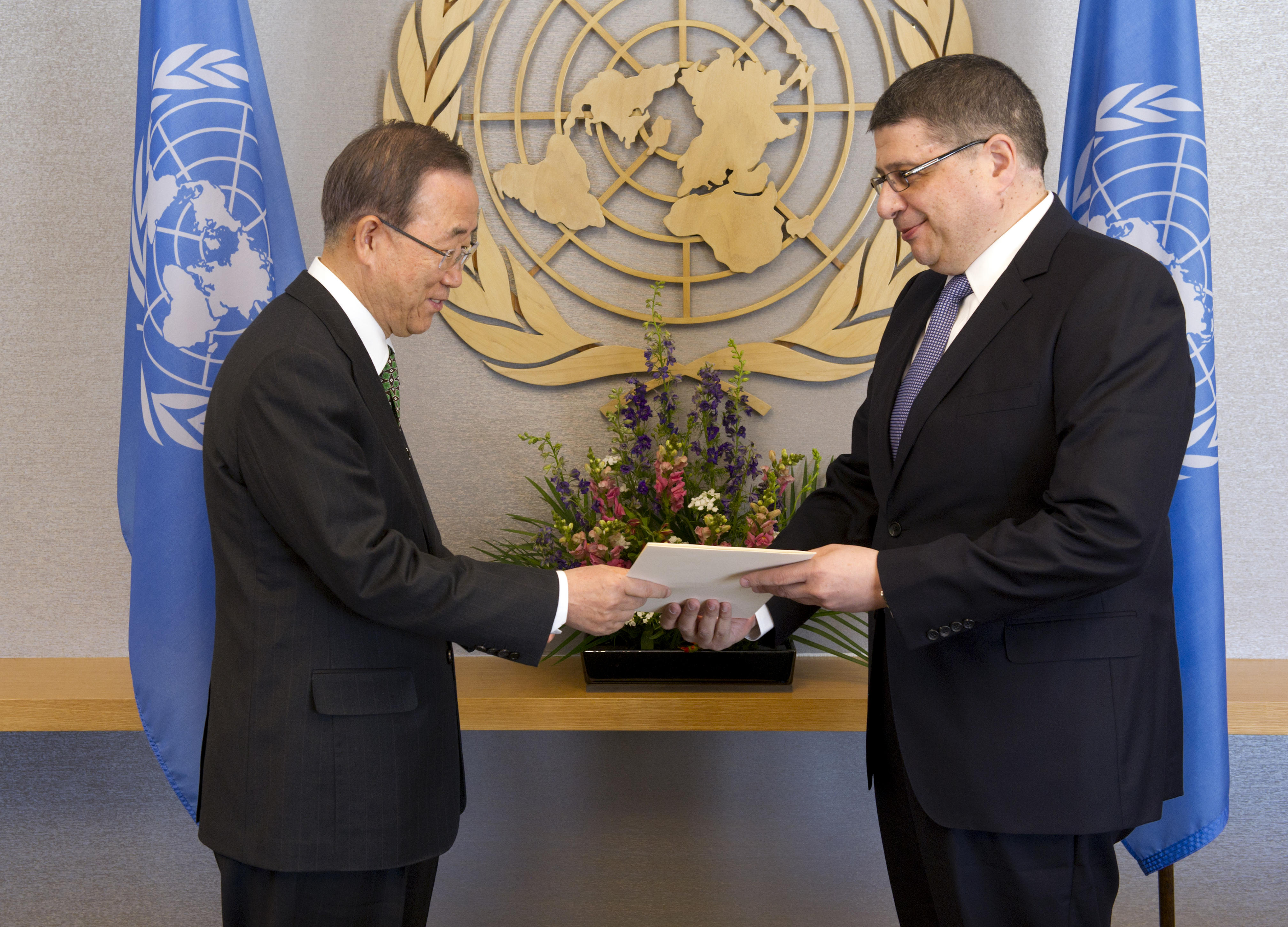
On 9 April, Ambassador Nicholas Emiliou presented his credentials to UN Secretary-General Ban Ki-moon as new Permanent Representative of the Republic of Cyprus to United Nations. Until his appointment, Mr. Emiliou was Permanent Secretary at the Ministry of Foreign Affairs in Nicosia from August 2008. [Read more…]