General Debate of the Preparatory Committee for the Conference of Plenipotentiaries on Prevention and Punishment of Crimes against Humanity, established in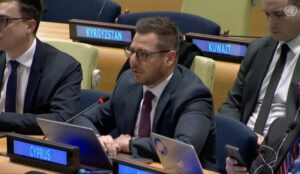 accordance with GA resolution 79/122
United Nations, 19 January 2026
Thank you, Mr. Chair.
Allow me, at the outset, to congratulate you on your election, and to wish you every success in the important work ahead. You may count on the full support of my delegation.
The Republic of Cyprus aligns itself with the statement delivered on behalf of the European Union and its Member States and wishes to make the following remarks in its national capacity.
Cyprus welcomes the adoption by the General Assembly, in 2024, of resolution 79/122. This resolution represents a landmark step and reflects the clear commitment and collective willingness of the international community to consolidate international criminal law, to strengthen the protection of human rights — in particular the rights of victims and potential victims — and to advance the rule of law, peace, and security.
Cyprus particularly welcomes the fact this resolution was adopted by consensus. This achievement underscores the shared determination of States to address a long-standing gap in the international legal framework and to enhance our collective capacity to combat impunity against the most serious international crimes.
As a first and essential step, we are gathered here today, in the framework of the Preparatory Committee.
Cyprus stands ready to engage constructively and in good faith in all aspects of the Committee’s work, with a view to ensuring that the Conference of Plenipotentiaries can efficiently conclude and adopt a legally binding international convention on the prevention and punishment of crimes against humanity. In this context, we attach particular importance to ensuring an inclusive process and encourage all delegations to engage constructively and in good faith in the work of the Committee.
Mr. Chair,
It is essential to recall the fundamental reason that brings us together today. A significant legal gap persists within the existing treaty framework governing the most serious international crimes. While war crimes and genocide are addressed by widely ratified conventions imposing clear obligations on States to prevent, punish, and cooperate in respect of those crimes, crimes against humanity — despite their gravity — remain without a dedicated treaty framework.
The absence of such a convention is all the more striking given that crimes against humanity may be committed both during armed conflicts and peace, and do not require the specific intent necessary for the establishment of genocide. Their occurrence and impact are no less devastating for victims, societies, and international peace and security.
A future convention would reinforce the central importance of prevention and punishment, while assisting States in harmonising relevant domestic legislation. It would also enhance inter-State cooperation, ensuring that perpetrators find no safe haven and strengthening deterrence and accountability.
Mr. Chair,
This step is long overdue, and a substantial body of work has already been accomplished. Cyprus recalls in particular the decision of the International Law Commission, in 2014, to include crimes against humanity in its program of work — a decision which my delegation commends. Following five years of rigorous and inclusive work, the Commission adopted its draft articles in 2019 and recommended that the General Assembly elaborate a legally binding instrument on the basis of those draft articles.
In this respect, Cyprus is of the view that the work of the International Law Commission already constitutes a sound and coherent foundation for our discussions. The draft articles provide a comprehensive framework, whose core elements should be maintained and further reinforced.
Cyprus attaches particular importance to ensuring that prevention remains at the heart of the future convention. Prevention is not only a legal obligation but also a practical tool for protecting human dignity, strengthening domestic institutions, and reinforcing international cooperation before atrocities occur.
Cyprus looks forward to contributing constructively to the work of the Preparatory Committee and to the success of this important process.
Thank you.