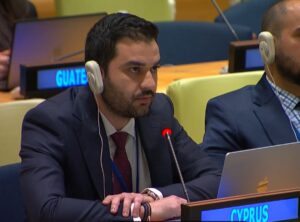
Item 84: The rule of law at national and international levels
United Nations, 9 October 2026
Thank you, Mr. Chair.
Cyprus aligns itself with the statement delivered by the representative of the European Union on behalf of the EU and its Member States and wishes to offer the following additional remarks in its national capacity.
We thank the Secretary-General for his report on strengthening and coordinating United Nations rule of law activities.
Mr. Chair,
Cyprus attaches the highest importance to the promotion and strengthening of the rule of law, both at the national and international levels.
At a time when the international legal order is under increasing pressure, upholding the rule of law means ensuring that international law is respected and applied consistently, and that relations among States are governed by law rather than by power. As the President of the Republic of Cyprus reaffirmed before this General Assembly only a few days ago, the Charter of the United Nations must remain our compass, irrespective of power, size or leverage.
Respect of a State’s sovereignty, political independence and territorial integrity are fundamental principles of international law. The prohibition of the use and the threat of use of force against the territorial integrity and independence of a State is a peremptory norm embodied in the UN Charter. To us, all are core elements of an international legal order founded on the rule of law and must apply uniformly and consistently regardless of the size, power or influence of any State.
Mr. Chair,
International law and the UN Charter cannot be applied selectively. Nor can the sovereignty and territorial integrity of a State become less deserving of protection because of the passage of time.
Cyprus speaks from experience. Fifty-two years after the illegal Turkish invasion, more than one third of the territory of the Republic of Cyprus remains under military occupation. thousands of forcibly displaced persons and their descendants continue to be prevented from returning to their homes, while fundamental human rights continue to be violated, despite final and binding judgments by International Courts [holding Turkey responsible for continuing human rights violations, in bold disregard by the violating state not only of its duty to abide by the Courts’ judgments, but also of its international obligations under binding rules of customary international law to cease such continuing violations].
For Cyprus, this experience not only supports our conviction that respect for international law must be universal and consistent, it is also a stark reminder that the rule of law at the international level requires also respect for individual rights and full compliance with binding judicial decisions.
Mr. Chair,
Cyprus has consistently supported the work of the International Law Commission and continues to attach great importance to its contribution to the codification and progressive development of international law.
The Commission and the Sixth Committee perform distinct but complementary functions. The Commission’s expert work benefits from the practice, legal views and observations of States, while the Sixth Committee provides the principal intergovernmental forum in which Member States consider the Commission’s work and determine the appropriate follow-up.
For this relationship to remain effective, sustained and substantive engagement by Member States is essential.
Recent developments demonstrate the practical value of this interaction.
Cyprus supported the decision to proceed towards the elaboration of a legally binding convention on the prevention and punishment of crimes against humanity, based on the draft articles prepared by the International Law Commission. We have considered those draft articles to constitute a sound and balanced basis for the negotiations.
We have likewise welcomed the process towards a legally binding instrument on the protection of persons in the event of disasters, based on the draft articles adopted by the Commission in 2016, which Cyprus has also regarded as a sound and balanced basis for the negotiations.
Mr. Chair,
At the national level, Cyprus remains committed to a legal order founded on democracy, the separation of powers, judicial independence and respect for human rights.
We continue our efforts to enhance the efficiency and transparency of the justice system, strengthen access to justice and accountability, and reinforce the framework for the prevention and combating of corruption. These remain central elements of our national commitment to the rule of law.
At the international level, our commitment is equally clear.
Cyprus will continue to support the peaceful settlement of disputes, the effective implementation of international obligations and the consistent application of international law.
Cyprus reiterates its steadfast support for the International Court of Justice and its central role in the peaceful settlement of international disputes. Full and effective compliance with its judgments is essential to safeguard the authority of the Court and the credibility of the international legal order.
We also reaffirm our support for the International Criminal Court as an independent and impartial judicial institution and for its essential role in combating impunity for the most serious crimes of concern to the international community. Cyprus continues to advocate for the universality and integrity of the Rome Statute and for the full implementation of its provisions.
Mr. Chair,
The rule of law ultimately depends not only on the existence of rules, but on their consistent application, implementation and observance.
Thank you, Mr. Chair.